Across the first three parts of our definitive guide, we have journeyed from definition to design and finally to demonstration. We decoded the fundamental language of biomimicry, traced its rich history, equipped ourselves with the innovator’s toolkit, and witnessed nature’s genius in action through a series of transformative case studies.
However, the path from a brilliant natural model to a successful market innovation is not without its challenges. While the promise of biomimicry is immense, a complete picture requires a balanced perspective. In this fourth and final installment, we will critically examine both the promise and the perils of the field, exploring the practical, economic, and ethical hurdles to its adoption. We will then cast our eyes to the horizon, charting the next frontier of bio-inspired innovation—from the nanoscale machinery of life to its powerful integration with artificial intelligence.
Part V: A Balanced Perspective: The Promise and Perils of Biomimicry
While the potential of biomimicry to drive a new wave of sustainable innovation is immense, its path from the laboratory to the marketplace is fraught with challenges. A balanced assessment requires acknowledging not only its transformative promise but also the significant practical, economic, and ethical hurdles that hinder its widespread adoption. The primary obstacle is not a lack of natural inspiration, but rather the systemic inertia of an industrial world whose core principles are often fundamentally misaligned with those of nature.
5.1 The Promise: A Pathway to a Regenerative Future
The advantages of adopting a biomimetic approach are compelling and extend far beyond clever engineering.
-
Sustainability and Circularity
Nature operates in closed-loop, waste-free cycles where the output of one process is the input for another. By emulating these systems, biomimicry provides a tangible blueprint for a circular economy. It encourages the use of locally attuned materials, life-friendly chemistry, and designs that are biodegradable or can be perpetually recycled, drastically reducing our environmental footprint.21
-
Enhanced Efficiency and Performance
As the case studies demonstrate, nature’s designs have been optimized over eons for maximum performance with minimum energy and material input. Translating these strategies leads to products and systems that are not just “greener” but objectively better—faster trains and use less energy, buildings that are more comfortable with lower utility bills, and materials with superior properties.8
-
Driving Innovation
By compelling designers, engineers, and scientists to look beyond their disciplines and into the living world, biomimicry serves as a powerful catalyst for breakthrough thinking. It opens up a vast, untapped solution space, leading to novel inventions and creating a significant competitive advantage for companies that embrace it.1
-
Resilience
Natural systems are inherently resilient, capable of adapting to disturbances and changing conditions. Mimicking the diversity, redundancy, and adaptability found in ecosystems can help us design more resilient infrastructure, supply chains, and communities that are better equipped to withstand the challenges of a changing climate.49
5.2 The Perils: Bridging the Gap from Biology to Boardroom
Despite its clear benefits, the implementation of biomimicry faces significant systemic barriers.
-
Complexity and Translation
Nature is profoundly complex. Translating a nuanced biological principle into a set of engineering specifications is a major challenge that requires deep, interdisciplinary collaboration.21 The “language barrier” between biologists, who describe complex systems, and engineers, who require precise parameters, is a well-documented hurdle. This gap often requires specialized “translators” or teams with rare, cross-disciplinary expertise 53
-
Cost and Scalability
The research and development phase for a biomimetic solution can be long and expensive.51 Furthermore, even a successful prototype faces the “valley of death” in manufacturing. Replicating nature’s intricate, hierarchical structures often requires novel manufacturing processes that do not fit neatly into existing, optimized industrial supply chains. This can make scaling up production prohibitively costly and risky, especially when competing with established, inexpensive, but unsustainable technologies 46
-
Lack of Awareness and Education
A fundamental barrier, identified in fields like construction, is a simple lack of knowledge.55 Many professionals have never been trained in biomimetic principles. Without awareness and education, designers will not know to “ask nature” in the first place, and managers will not understand the value proposition to justify the investment 53
5.3 The Ethical Tightrope: Navigating Biopiracy and Anthropocentrism

The practice of biomimicry also walks a fine ethical line, forcing us to confront difficult questions about our relationship with the natural world.
-
Intellectual Property and Biopiracy
Who owns nature’s genius? When a company patents a design based on an organism’s strategy, it raises profound questions about the commercialization of a shared biological heritage. This issue becomes particularly contentious when the inspiration is linked to the traditional ecological knowledge of indigenous communities, who may have understood a particular natural principle for centuries. Current intellectual property laws, designed for human inventions, are ill-equipped to handle these complexities, creating a risk of “biopiracy”—the appropriation of biological knowledge without fair compensation or credit.51
-
The Risk of Anthropocentrism
A core ethical danger is that biomimicry could inadvertently reinforce an anthropocentric worldview—the idea that humans are separate from and superior to nature, which exists primarily as a resource for our use.56 If we only view nature as a “toolbox” or a collection of clever “patents” to be exploited, we miss the deeper lesson. True biomimicry, as envisioned by its proponents, requires a fundamental shift to an ecocentric perspective, one that recognizes the intrinsic value of all life and sees humanity as an integrated part of the web of life.56
-
Unintended Consequences
A biomimetic technology is not inherently good. Its impact depends on the system into which it is integrated. A hyper-efficient water pump inspired by plant vascular systems could be used to sustainably irrigate crops or to deplete a fragile aquifer more quickly. Without a systemic, life-cycle perspective, even the most elegant biomimetic solution can contribute to unsustainable outcomes 56
Ultimately, the challenges facing biomimicry are less about scientific discovery and more about overcoming the inertia of our existing systems. The short-term profit motives, linear “take-make-waste” supply chains, and siloed educational and corporate structures of the modern industrial economy are fundamentally at odds with nature’s long-term, cyclical, and deeply interconnected principles. The struggle to implement biomimicry is therefore a microcosm of the larger societal struggle to transition from an extractive economy to a regenerative one. The field’s success will be a barometer of our collective willingness to adopt not just nature’s designs, but its core operating principles.
Part VI: The Next Frontier: Charting the Future of Bio-Inspired Innovation
As our understanding of biology deepens and our technological capabilities advance, the field of biomimetics is evolving. The future of bio-inspired innovation is being shaped by a convergence of trends that push the boundaries of what is possible, moving from mimicking visible forms to emulating life’s most fundamental processes. This frontier is defined by two complementary movements: “going smaller” to master the nanoscale machinery of life, and “thinking bigger” to understand the grand timescale of evolution.
6.1 Downsizing to the Nanoscale: The Rise of Nanobiomimetics
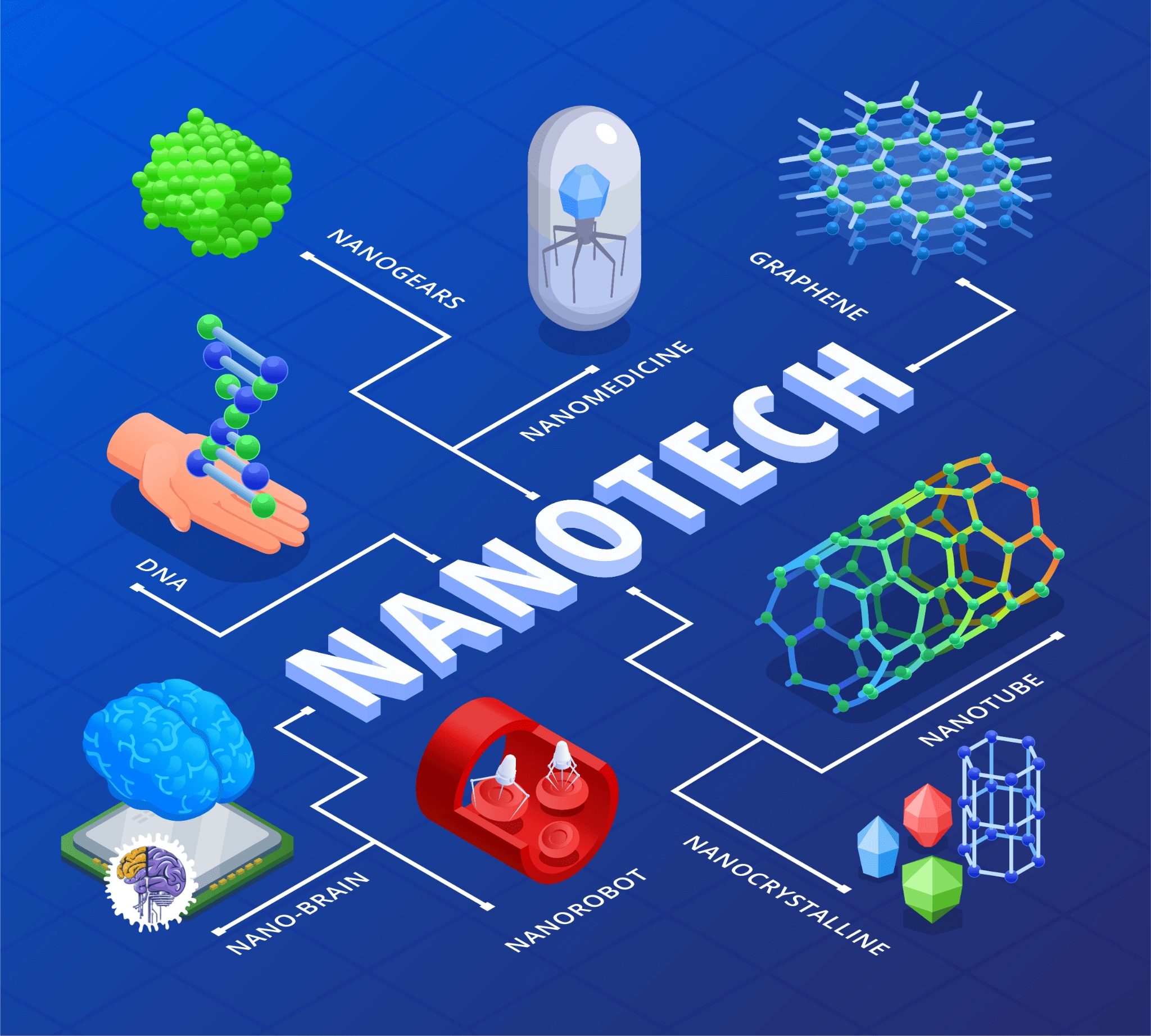
The most significant technological shift in biomimetics is the move from the macro and micro scales to the nano scale.16 “Nanobiomimetics” involves the transfer of molecular biological principles into technological applications, a domain considered by some to be the field’s final frontier.22 By learning to build with the precision of nature—molecule by molecule—we can unlock unprecedented functionalities.
Potential Applications
-
Medicine
The potential for revolutionizing healthcare is immense. Researchers are designing nanosized drug delivery vehicles inspired by molecular motors (like kinesin and dynein in our cells) that can transport therapeutic agents directly to specific cells, improving efficacy and dramatically reducing side effects. Bioinspired nanomaterials that mimic the structure of the extracellular matrix can serve as scaffolds to promote tissue regeneration and wound healing.22
-
Materials Science
The future of materials lies in creating “smart” substances that are adaptive and self-reliant. This includes materials with self-healing properties inspired by biological repair mechanisms, which could dramatically increase product longevity, and adaptive materials that change their properties (e.g., color, permeability, stiffness) in response to environmental stimuli.22
-
Energy and Environment
Nanobiomimetics offers pathways to cleaner energy and a healthier environment. This includes developing systems that mimic the high efficiency of photosynthesis to harvest solar energy, and creating advanced filter membranes with nano-pores inspired by cellular aquaporins for highly efficient water purification.22
6.2 Beyond Optimization: Understanding Evolution with Evomimetics
While technology allows us to go smaller, a new conceptual framework is pushing us to think bigger. The emerging field of “Evomimetics” argues that to truly succeed, we must understand not just the biological solution but the evolutionary story behind it.57
-
The Problem with “Perfection”
A common misconception in biomimicry is that evolution produces perfectly optimized, flawless designs. The reality is that organisms are not ideal machines; they are products of their unique evolutionary history, full of constraints and trade-offs.57 A structure might be a “good enough” solution that is limited by the genetic material available, or it might perform one function exceptionally well at the expense of another.
-
The Evomimetic Approach
Instead of simply copying a final form, evomimetics seeks to understand the evolutionary path that led to that form. By analyzing the selective pressures, functional trade-offs, and phylogenetic constraints an organism faced, we gain a much deeper understanding of why a design is the way it is. This contextual knowledge is crucial for engineers, as it helps them avoid the pitfall of copying a biological feature without understanding its inherent limitations or the context in which it works best.57
6.3 The Symbiotic Future: Integrating AI, Robotics, and Advanced Manufacturing
The acceleration of biomimetic innovation is being supercharged by a symbiosis with other cutting-edge technologies.
-
AI and Evolutionary Algorithms
The sheer volume of biological knowledge is immense. Artificial intelligence and machine learning can be used to rapidly search vast biological databases and scientific literature to identify promising natural models for specific engineering functions. Furthermore, evolutionary algorithms—optimization techniques inspired by the process of natural selection—are being used to design and refine complex systems, from the neural networks in neuroprosthetics to the flapping mechanisms of robotic birds 58
-
Advanced Manufacturing
For decades, our ability to manufacture complex, hierarchical structures has lagged behind our ability to observe them in nature. Technologies like high-resolution 3D printing are finally closing this gap. It is now possible to fabricate intricate geometries that were once impossible, allowing for the creation of products that more faithfully replicate the functional elegance of natural structures, such as the internal ventilation networks of a termite mound or the lightweight, impact-resistant architecture of a sea urchin spine 54
-
Marine Robotics
One of the most active frontiers is marine robotics, where the challenges of navigating a harsh, dynamic environment are immense.62 Robots that mimic the efficient propulsion of fish, the sensing capabilities of seals, or the cooperative behavior of schooling fish are being developed for applications in ocean exploration, resource monitoring, and environmental cleanup.62
The future of biomimetics lies in the synthesis of these trends. To build a truly effective nanorobot inspired by a cellular motor, we must first understand the evolutionary trade-offs that shaped that motor’s function over millions of years. To model those evolutionary pathways, we need the immense computational power of AI. This convergence represents the ultimate maturation of the discipline, moving beyond simple imitation to a deep, systemic, and predictive understanding of life’s operating system.
Conclusion
As we’ve seen, the journey of biomimicry is one of profound potential tempered by significant real-world challenges. While it offers a clear pathway to a regenerative future, its implementation is hindered by systemic barriers, from the complexity of translation to critical ethical questions. The true challenge lies not in finding nature’s genius, but in realigning our industrial systems with its core principles.
Yet, the future of bio-inspired innovation is brighter and more ambitious than ever. By venturing into the nanoscale, seeking a deeper evolutionary understanding, and forging a powerful symbiosis with AI and advanced manufacturing, the field is moving beyond simple imitation. The next frontier is about achieving a deep, systemic, and predictive understanding of life’s operating system, promising solutions that are not only inspired by nature but are created in partnership with its deepest wisdom.
Clarifying the Concepts
How did a kingfisher help design a quieter, more efficient bullet train?
The Shinkansen bullet train in Japan created a loud “tunnel boom” when exiting tunnels. Engineers, inspired by the kingfisher’s ability to dive into water with almost no splash, redesigned the train’s nose to mimic the bird’s beak. This new shape reduced air resistance by 30%, making the train 10% faster and 15% more energy-efficient while eliminating the loud boom.
What can a humpback whale teach us about making better wind turbines?
The leading edge of a humpback whale’s flipper has bumps called tubercles, which control water flow and prevent stalling, allowing for incredible agility. By applying this “tubercle effect” to turbine blades, engineers created blades that are over 20% more energy-efficient and can generate more power in a wider range of wind speeds.
Is it true that a building in Africa is cooled by mimicking a termite mound?
Yes. The Eastgate Centre in Harare, Zimbabwe, uses a passive cooling system inspired by the ingenious design of termite mounds. It uses thermal mass and a system of vents to “breathe,” regulating its internal temperature without conventional air-conditioning. This design uses less than 10% of the energy of a comparable building.
What is the “Lotus Effect” and how is it used in products?
The “Lotus Effect” describes the self-cleaning property of the lotus leaf. Its surface has a special micro- and nano-scale texture that makes it superhydrophobic, causing water to bead up and roll off, taking dirt with it. This principle is now used in products like self-cleaning paints (Lotusan®), glass, and textiles.
How can shark skin be useful for both Olympic swimmers and hospitals?
A shark’s skin is covered in microscopic textures called dermal denticles that serve two functions. They reduce drag, which inspired high-performance swimsuits like Speedo’s LZR Racer. They also create a surface that is difficult for bacteria to colonize, leading to the development of antimicrobial surfaces (like those from Sharklet Technologies) used in hospitals to prevent infections without chemicals.
The Shinkansen bullet train in Japan created a loud “tunnel boom” when exiting tunnels. Engineers, inspired by the kingfisher’s ability to dive into water with almost no splash, redesigned the train’s nose to mimic the bird’s beak. This new shape reduced air resistance by 30%, making the train 10% faster and 15% more energy-efficient while eliminating the loud boom.
The leading edge of a humpback whale’s flipper has bumps called tubercles, which control water flow and prevent stalling, allowing for incredible agility. By applying this “tubercle effect” to turbine blades, engineers created blades that are over 20% more energy-efficient and can generate more power in a wider range of wind speeds.
Yes. The Eastgate Centre in Harare, Zimbabwe, uses a passive cooling system inspired by the ingenious design of termite mounds. It uses thermal mass and a system of vents to “breathe,” regulating its internal temperature without conventional air-conditioning. This design uses less than 10% of the energy of a comparable building.
The “Lotus Effect” describes the self-cleaning property of the lotus leaf. Its surface has a special micro- and nano-scale texture that makes it superhydrophobic, causing water to bead up and roll off, taking dirt with it. This principle is now used in products like self-cleaning paints (Lotusan®), glass, and textiles.
A shark’s skin is covered in microscopic textures called dermal denticles that serve two functions. They reduce drag, which inspired high-performance swimsuits like Speedo’s LZR Racer. They also create a surface that is difficult for bacteria to colonize, leading to the development of antimicrobial surfaces (like those from Sharklet Technologies) used in hospitals to prevent infections without chemicals.
Reference
[1]. Biomimicry – Japanese Trains Mimic Kingfisher | BirdNote, accessed on June 14, 2025, https://birdnote.org/podcasts/birdnote-daily/biomimicry-japanese-trains-mimic-kingfisher
[2]. How one engineer’s birdwatching made Japan’s bullet train better – Trellis Group, accessed on June 14, 2025, https://trellis.net/article/how-one-engineers-birdwatching-made-japans-bullet-train-better/
[3]. The Kingfisher and the Bullet Train – Minimal Format | PDF – Scribd, accessed on June 14, 2025, https://www.scribd.com/document/847058777/The-Kingfisher-and-the-Bullet-Train-Minimal-Format
[4]. Biomimicry is Real World Inspiration – Carnegie Museum of Natural History, accessed on June 14, 2025, https://carnegiemnh.org/biomimicry-is-real-world-inspiration/
[5]. The Art of Biomimicry in Architecture, Design and Engineering – Built | The Bluebeam Blog, accessed on June 14, 2025, https://blog.bluebeam.com/art-of-biomimicry-in-architecture/
[6]. Architects Look to Termite Mounds to Improve Building Ventilation …, accessed on June 14, 2025, https://www.lviassociates.com/en-us/industry-insights/hiring-advice/architects-look-to-termite-mounds-to-improve-building-ventilation
[7]. The Top 10 Real World Examples of Biomimicry in Architecture, accessed on June 14, 2025, https://www.learnbiomimicry.com/blog/top-10-biomimicry-examples-architecture
[8]. Biomimetics: forecasting the future of science, engineering, and medicine – PMC, accessed on June 14, 2025, https://pmc.ncbi.nlm.nih.gov/articles/PMC4572716/
[9]. Biomimicry in Architecture: 10 Nature-Inspired Examples – The Overview, accessed on June 14, 2025, https://www.theoverview.art/biomimicry-in-architecture-examples/
[10]. The Wonders of Biomimicry: Engineering Inspired by Nature – Kids Discover, accessed on June 14, 2025, https://kidsdiscover.com/teacherresources/the-wonders-of-biomimicry-engineering-inspired-by-nature/
[11]. Lotus Effect – Self-Cleaning Surfaces | NTSN, accessed on June 14, 2025, https://www.nanotech-solutions.com/en/nano/lotus-effect
[12]. (PDF) Self-Cleaning Surfaces Using the Lotus Effect – ResearchGate, accessed on June 14, 2025, https://www.researchgate.net/publication/279947715_Self-Cleaning_Surfaces_Using_the_Lotus_Effect
[13]. (PDF) Self-Cleaning Surfaces Using the Lotus Effect – ResearchGate, accessed on June 14, 2025, https://www.researchgate.net/publication/279947715_Self-Cleaning_Surfaces_Using_the_Lotus_Effect
[14]. Lotus effect: Self-cleaning bioplastics repel liquid and dirt – RMIT University, accessed on June 14, 2025, https://www.rmit.edu.au/news/media-releases-and-expert-comments/2021/aug/self-cleaning-bioplastic
[15]. Bioinspired Photocatalytic Shark-Skin Surfaces with Antibacterial …, accessed on June 14, 2025, https://pmc.ncbi.nlm.nih.gov/articles/PMC6013830/
[16]. Biomimetics and Living Machines: How Lessons from Nature Can Transform Technology, accessed on June 14, 2025, https://www.kallmorris.com/columns/biomimetics-and-living-machines-how-lessons-from-nature-can-transform-technology
[17]. Attacking bacteria with shark skin-inspired surfaces – American Chemical Society, accessed on June 14, 2025, https://www.acs.org/pressroom/presspacs/2018/acs-presspac-june-13-2018/attacking-bacteria-with-shark-skin-inspired-surfaces.html
Discussion
Of the incredible solutions discussed in this article—the kingfisher’s beak, the whale’s flipper, the termite’s mound, the lotus leaf, and the shark’s skin—which case study do you find the most impressive or inspiring? Share your thoughts in the comments!
To create truly regenerative solutions, you must first speak the language. Master the essential vocabulary of biomimicry and sustainable innovation here.
Discover how a bird’s beak, a human bone, and a common weed inspired some of the world’s most revolutionary innovations, from bullet trains to Velcro.
Discover the Stories
Facebook
Twitter
Whatsapp
Telegram
Linkedin
Link